
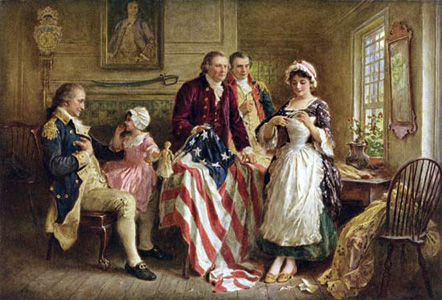
The Betsy Ross Banner
The Birth of the Stars and Stripes
Before the revolutionary struggle for independence, the American colonies flew individual regional colors, militia banners, or various modifications of the British merchant ensigns. As the colonies unified under a singular cause, the necessity for a standardized national symbol became clear.
According to historical tradition, in June of 1776, a small congressional committee consisting of George Washington, Robert Morris, and George Ross visited upholsterer Betsy Ross in her Philadelphia shop. Washington presented a rough sketch of a flag featuring thirteen red and white alternating stripes and thirteen six-pointed stars.
Ross elegantly demonstrated how to cut a perfect five-pointed star with a single snip of her shears and suggested arranging the stars in a circular pattern. This circle configuration carries deep symbolic meaning, ensuring that no single colony or state would take precedence or sit superior over another—signifying perfect equality in the emerging Union.
This traditional layout was officially validated on June 14, 1777, when the Second Continental Congress passed the historic Flag Resolution, declaring: "Resolved, That the flag of the United States be thirteen stripes, alternate red and white; that the union be thirteen stars, white in a blue field, representing a new Constellation."